
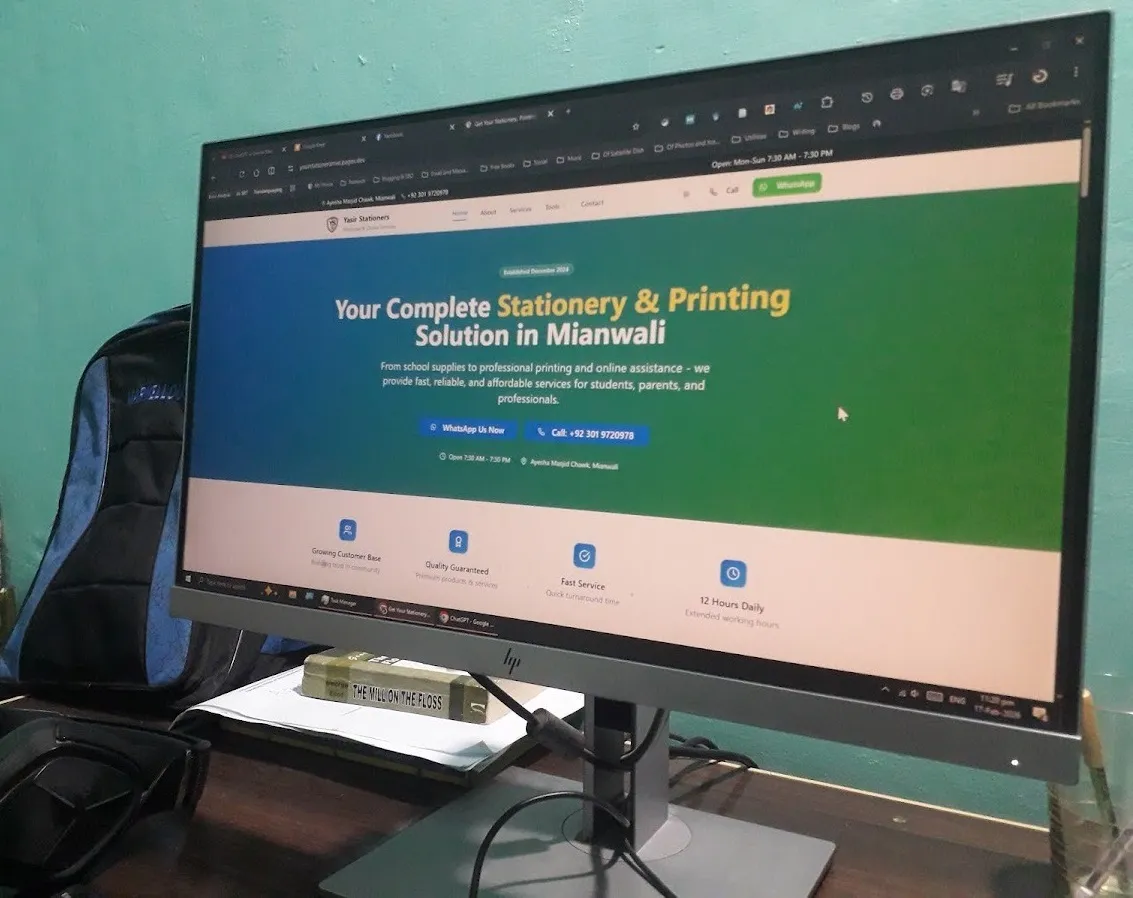
Businesses serving local communities usually don't need an online presence, but I thought this would be an excellent opportunity to test out the strategy for optimizing a business for local SEO. For those who don't know, Yasir Stationers is our very own business that we started to serve the local community in Mianwali by offering affordable articles of stationery and printing solutions. As I have already alluded to before, businesses in Mianwali acquire their recognition from word-of-mouth of their customers, not from their online presence, as most of the people don't even know that they can search about businesses in their vicinity on Google Maps and even in products powered by generative AI, particularly ChatGPT, if you ask about notable businesses in a specific location.
Local SEO, as the name suggests, limits the visibility of a certain item, in our case, our business, to a certain geographical location. Therefore, its successful implementation hinges on the actual GPS location of the device the search query was typed from. But the appearance of your business in the SERP, even if the requirement of location is fulfilled, is dependent on other factors, such as the working hours of your business, the use of appropriate keywords, the completeness of your GMB (Google My Business) profile, and the (number of as well as the content of) reviews on your GMB listing. In this case study, I am going to detail the procedure and the outcome of the local SEO I did for our business.
The Procedure
The first step in local SEO is to create a Google My Business profile. The main benefits of a GMB profile are that your business starts appearing on Google Maps and even in Google Search. Make sure that you have provided authentic and ample information about your business. I entered the following details when I created the profile:
The name of your business: Don't make it too long; the first two defining keywords of your business alongside your name are the sweet spot here. Example: Yasir (being the name of the proprietor) Stationers & Photostat (the defining keywords of our business). Make sure it matches with the front sign of your shop. Mismatch between the two will result in the suspension of your GMB profile.
Business Category: The category your business falls into. If your business offers multiple adjacent services, the service that is the primary focus of your business should be set as the primary category, while other service(s) can be set as secondary categories. Do not add irrelevant categories. For our business, we went with "Stationery shop" as the primary category and "Copy shop" as the secondary.
Description: This is the crux of your business. Write a small paragraph of 3 to 5 sentences, detailing what (services) your business offers. This is where you will use relevant keywords, but don't stuff them. This is the description we went with. It isn't great but does the job:
"We provide a complete range of school and office stationery and high-quality photocopying and printing services for both B&W and color printing. Need help with online tasks? We assist with student admissions, job applications, and internet-based services. Fast, reliable, and affordable, visit us for all your printing and stationery needs." (As you can see, we didn't just use the word "stationary" in isolation but appended "school" and "office" before it so that people searching with these terms will see our business. Same goes for student admission and job applications)
Contact information: People will be able to call and send messages directly to you(r buainess).
Website and Social Media Links: Not mandatory but can enhance the professional appearance of your business (profile).
Location on Map: This is an extremely important input field for your business. This will help your business show up on Google Maps when someone zooms in on the place your shop is situated in or searches with relevant keywords appended with "near me" in Google.
Working Hours: Albeit tedious, this section also determines your ranking, so add your actual working hours.
Shop Logo: I used Nano Bana Pro to make a logo for our shop and uploaded it onto our GMB listing. It appears before the name of your business.
Exterior and Interior Photos: Upload actual pictures of the exterior and the interior of your shop, with geolocation data stored in the EXIF tags of the images. This will help pinpoint the location of your business on Google Maps if you cannot provide the actual location. The pictures you upload won't show up at once. It usually takes around 5 to 24 hours for your media to be reviewed.
Services Offered: This is a section separate from the standard GMB editor. Add services in their respective categories you declared. In our case, we added stationary offerings in the Stationary store section and the photostat services in the Copy shop category.
Then I asked for the reviews from the customers.
After the GMB profile was created and approved by Google, I made a Facebook page and a website for our business. I used the Skyworks AI agent with a detailed prompt to create the website and took help from Gemini CLI and Google Antigravity (with Claude Opus 4.5 + 4.6) to add features, such as PDF and image manipulation tools. I used Cloudflare Pages to deploy this site.
The Outcome
The GMB profile did not rank in its initial days. But it started to catch up for the terms, such as "Stationary shop near me", "photostat shop near me", "copy shop near me" and "printing shop near me," etc. The ranking of our shop stayed on top for the terms. "Stationary shop near me" and "photostat shop near me" when I searched for the term 550 meters away (from the shop). The ranking went down quite a lot when I searched for the terms when our working hours were closed.
Change of Ranking with Different Keywords and Working Hours
Copy shop near me: Rank 1 (Within Working Hours) vs Rank 5 (After Working Hours)
Stationary shop near me: Rank 2 vs Rank 3
Photostat shop near me: Rank 1 vs Rank 4
Photocopy shop near me: Not ranked (0) vs Not ranked (0)
Printing shop near me: Rank 3 vs Rank 9
* The rankings were checked in Incognito mode without being signed into any Google account on mobile data.
As is obvious, working hours are an important determinant of rankings, alongside the main name and category of your business, as the GMB listing of our shop ranked well for the keywords that were included in the name, category, and description of our shop (such as "Photostat"), and our ranking tanked as soon as I searched after the disclosed working hours of our shop. As for the ranking of our shop's website, it's placed second after the video and GMB results for the search term "Stationary shop in Mianwali".
Conclusion
What I've learned from this experiment is that local SEO requires how people in the target location search/approach the business. The most common mistake I've seen businesses repeat is that they develop copy for their business sites without even mentioning the location of their business. Even factors that may appear negligible determine the ranking of your business, such as the working hours for our business. And thus, their site or GMB listing does not even show up when people in their vicinity search for it. The main reason you should focus on the local SEO of your business is to make your business discoverable in the answers provided by the AI. Most AI products have already integrated features related to memory and the location of the user, so if he prompts that he needs his assignment printed, the AI can automatically recommend your business.